
RetroBet Odds Format: Decimal, Fractional, American
Understanding how to read betting odds is a fundamental skill for any punter. Different formats can be confusing, but platforms like RetroBet often display all three major types to cater to a global audience. This guide provides a clear, practical breakdown of Decimal, Fractional, and American odds, explaining exactly how they work and how to calculate your potential winnings on each.
1. Decimal Odds: The Modern Standard
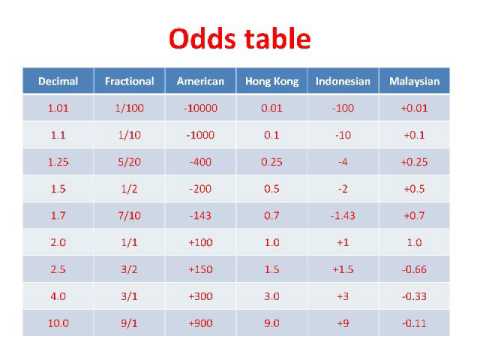
Decimal odds are the most common format used in Europe, Australia, and Canada. They are straightforward and easy to understand. The number simply represents the total amount you will get back for a one-unit stake, including your original wager. To calculate your potential profit, you use the formula: (Stake x Odds) - Stake = Profit. For example, if you place a $10 bet at odds of 2.50, your total return would be $10 x 2.50 = $25. Your profit would be $25 – $10 = $15. This simplicity makes decimal odds a favorite for many bettors at retrobet and other major sportsbooks.
2. Fractional Odds: The Traditional Approach
Commonly used in the UK and Ireland, fractional odds (e.g., 5/1 or 2/5) represent the profit you stand to make relative to your stake. The number on the left (numerator) is the profit, while the number on the right (denominator) is the stake required to win that amount. So, odds of 5/1 mean you profit $5 for every $1 you bet. Your total return would be $6 ($5 profit + $1 stake). For odds-on favorites, like 2/5, you would need to bet $5 to profit $2, for a total return of $7. While this format is traditional, new punters might find it less intuitive than decimals.
3. American (Moneyline) Odds: Plus and Minus
American odds are centered around winning or risking $100. They are expressed with either a plus (+) or minus (-) sign.
- Negative Odds (-): Indicate the favorite. The number shows how much you need to bet to win $100. For example, -200 means you must bet $200 to win a $100 profit.
- Positive Odds (+): Indicate the underdog. The number shows how much you would win from a $100 bet. For example, +300 means a $100 bet would yield a $300 profit.
This format is standard in the United States but can be confusing for international users. Most sites, including RetroBet casino, allow you to switch between formats in your account settings.
4. Converting Between Different Odds Formats
Being able to mentally convert between odds formats is a useful skill for comparing prices across different bookmakers. Here is a quick reference table for common conversions.
| Probability | Decimal | Fractional | American |
|---|---|---|---|
| 80% | 1.25 | 1/4 | -400 |
| 66.6% | 1.50 | 1/2 | -200 |
| 50% | 2.00 | 1/1 (Evens) | +100 |
| 20% | 5.00 | 4/1 | +400 |
| 10% | 10.00 | 9/1 | +900 |
5. Applying This Knowledge at RetroBet
Now that you understand the formats, you can use this knowledge to make informed bets. Always check which format is displayed in your settings to avoid costly miscalculations. A key strategy is to shop for the best odds, as a slight difference can significantly impact your long-term profitability. For instance, a RetroBet promo code might grant a RetroBet bonus like a RetroBet no deposit offer or RetroBet free spins, but understanding the underlying odds on the games you play is what truly empowers you. To see these formats in action on a live platform, you can visit RetroBet Australia.
6. Key Takeaways for Smart Betting
Mastering odds formats is your first step toward becoming a savvy bettor. Remember that odds represent a bookmaker’s implied probability of an outcome. Lower odds indicate a higher probability, while higher odds indicate a lower probability. Your goal is to find instances where you believe the actual probability of an event is greater than what the odds imply. This is known as finding “value.” Whether you prefer the simplicity of decimals, the tradition of fractions, or the Americana of moneylines, the fundamental principle remains the same: successful betting is about more than just luck—it’s about informed calculation.